


You know that feeling.
You’ve just finished a meal—maybe it wasn’t even that big—and instead of feeling energized or satisfied, you feel… stuck. Heavy. Like there’s a brick sitting somewhere in your stomach that just refuses to move. Or maybe it’s the bloating that creeps up on you later in the day, making your waistband feel like a vice grip, or that embarrassing rumble of gas when you’re in a quiet room.
We’ve all been there. And in our modern world, we’ve kind of accepted this as “normal.” We pop an antacid, complain about “getting old,” and move on.
But here is the thing: Ayurveda says this is absolutely not normal. In fact, it’s a warning light.
In Ayurveda, digestion isn’t just about processing food. It is the absolute foundation of everything. It is the engine of your life. If your digestion is weak, your health is weak. Period. It doesn’t matter if you are eating the most expensive, organic, nutrient-dense superfoods on the planet—if your body can’t break them down and absorb them, they are useless. Actually, worse than useless. They become toxic.
This brings us to two concepts you need to understand: Agni and Ama.
Think of Agni as a literal fire burning inside your belly. When a fire is strong and bright, you can throw a heavy log on it, and it burns it to ash, creating heat and energy. That’s healthy digestion. But if that fire is weak—flickering, smoking, barely alive—and you throw that same log on it? It doesn’t burn instead It just sits there as it creates smoke.
That smoke, that leftover sludge, is what Ayurveda calls Ama. It’s a sticky, toxic residue that clogs up your system.
So when you feel that gas, bloating, heaviness, or acidity, it’s basically your body telling you, “Hey, the fire is dying down here, and the smoke is building up.”
The good news? You don’t need harsh chemicals to fix this. You don’t need to live on boiled vegetables for the rest of your life. Ayurveda offers solutions that are safe, natural, and actually address the root cause—fixing the fire itself—rather than just masking the symptoms.
Let’s dive deep into how to get that fire burning bright again.
What Is Weak Digestion According to Ayurveda?

So, what is actually happening when we say digestion is “weak”?
In technical Sanskrit terms, we call this Mandagni. “Manda” means slow or dull, and “Agni” is fire. It literally translates to a dull fire.
Most of us think of digestion as a mechanical process: teeth chew, stomach churns, intestines absorb. But Ayurveda sees it as a transformation. Agni is responsible for transforming the external world (food) into your internal world (blood, muscle, bone, and energy). It is the gatekeeper.
When your Agni is strong, you extract the best part of your food—the Ojas, or vitality. You feel light, clear-headed, and energetic after eating.
But when Agni is weak (Mandagni), that transformation fails.
The food sits in the stomach too long. It starts to ferment. This fermentation produces gas (air) and sourness (acidity). Because the body can’t process the nutrients effectively, your metabolism slows down. Your immunity drops because, instead of fighting off viruses, your body is wasting all its energy trying to deal with the rotting food in your gut.
This is why, in Ayurveda, we say that nearly all diseases begin in the gut.
If you have Mandagni, you are essentially carrying around a trash can that never gets fully emptied. Over time, that waste (Ama) moves from your gut into your joints (arthritis), your skin (acne/eczema), or your blood (cholesterol). It all starts with that flickering flame in the belly.
Common Symptoms of Weak Digestion & Gas

How do you know if you have weak Agni? You probably already know, but let’s look closer at the signs. It’s rarely just one thing; it’s usually a cluster of nagging issues that we tend to ignore.
- Excessive gas and bloating This is the big one. If you wake up with a flat stomach but look six months pregnant by 4 PM, that is weak digestion. It means food is fermenting instead of digesting.
- Heaviness after meals You should feel satisfied after eating, not comatose. If you eat lunch and immediately feel like you need a nap, or if you feel a physical weight in your abdomen that lasts for hours, your fire isn’t strong enough to process the fuel you just gave it.
- Indigestion and acidity This is that burning sensation, the sour burps, or just a general feeling of “unease” in the upper stomach. It’s often a sign that the body is trying to overcompensate for weak digestion by producing too much acid, or that the food is simply sitting there too long.
- Loss of appetite This is a huge indicator that we often overlook. If it’s lunch time and you aren’t actually hungry, but you eat anyway because “it’s time to eat,” you are piling more work onto an already exhausted system. A lack of true hunger means the previous meal hasn’t been digested yet.
- Constipation or irregular bowel movements If you aren’t eliminating waste daily, and completely, that waste backs up. It dampens the digestive fire further. You should feel light and completely empty after a bowel movement. If you don’t, that’s a symptom.Bad breath or coated tongue Go look in the mirror right now. Stick out your tongue. Is there a thick white or yellowish coating on the back? That isn’t just “morning breath.” That is a visible layer of Ama (toxins) showing up in your mouth. It’s a direct reflection of what’s happening in your gut.
Main Causes of Weak Digestion
“Why is this happening to me?”
It’s usually not bad luck. It’s usually us. We live in a way that is almost perfectly designed to destroy our digestive fire.
Dietary Causes
Overeating and irregular meal timings This is the number one culprit. Imagine a campfire. If you throw a huge bundle of wet logs onto a small flame, what happens? The fire suffocates. That’s overeating. And irregular timing? That’s like trying to start a fire, letting it die, starting it again, and then pouring water on it. Your body loves rhythm. If you eat breakfast at 8 AM one day and 11 AM the next, your Agni gets confused. It doesn’t know when to prepare the digestive juices.
Cold, fried, and processed foods Your digestion is a heat process. It burns. When you drink ice water or eat ice cream, you are literally pouring cold water on a fire. The blood vessels in your stomach constrict, and enzyme production stops. Fried and processed foods are heavy and dead. They require massive amounts of energy to break down, depleting your Agni.
Incompatible food combinations (Viruddha Ahara) This is a unique Ayurvedic concept. Some foods just fight each other in the stomach. The classic example is fruit with dairy. A strawberry milkshake sounds nice, but fruit digests very quickly, while milk digests slowly. When you mix them, the fruit gets trapped in the stomach by the curdling milk, it ferments, and boom—you have toxins.
Lifestyle Causes
Stress, anxiety, and lack of sleep There is a direct highway between your brain and your gut (the gut-brain axis). When you are stressed, your body goes into “fight or flight” mode. It diverts blood away from the stomach and to your muscles (so you can run from the tiger). Digestion shuts down. If you eat when you are anxious or angry, that food turns into poison.
Sedentary lifestyle Fire needs air to burn. Movement circulates air (Vata) in the body. If you sit at a desk for 8 hours, the physical compression on your abdomen and the lack of blood flow stagnates your digestion.
Eating late at night The sun rules our digestion. When the sun is highest (noon), our Agni is strongest. When the sun goes down, our Agni goes to sleep. Eating a heavy meal at 9 PM is a disaster. The body wants to detox and repair while you sleep, not digest a cheese pizza.
Dosha Imbalance
Everyone is different, and the “flavor” of your indigestion depends on your Dosha.
- Vata-related gas: If you are a Vata type (air/space), your digestion is variable. It flickers like a candle in the wind. You are prone to gas, bloating, constipation, and dry stools.
- Kapha-related heaviness: If you are a Kapha type (earth/water), your digestion is slow and heavy. You might not have gas, but you feel sluggish, you gain weight easily, and you feel like food sits in your stomach for days.
Ayurvedic Remedies for Weak Digestion and Gas
Okay, let’s get to the practical stuff. How do we fix this?
The beauty of Ayurveda is that your kitchen is your pharmacy. You don’t need obscure herbs from the Himalayas for basic digestive issues. You likely have everything you need right now.
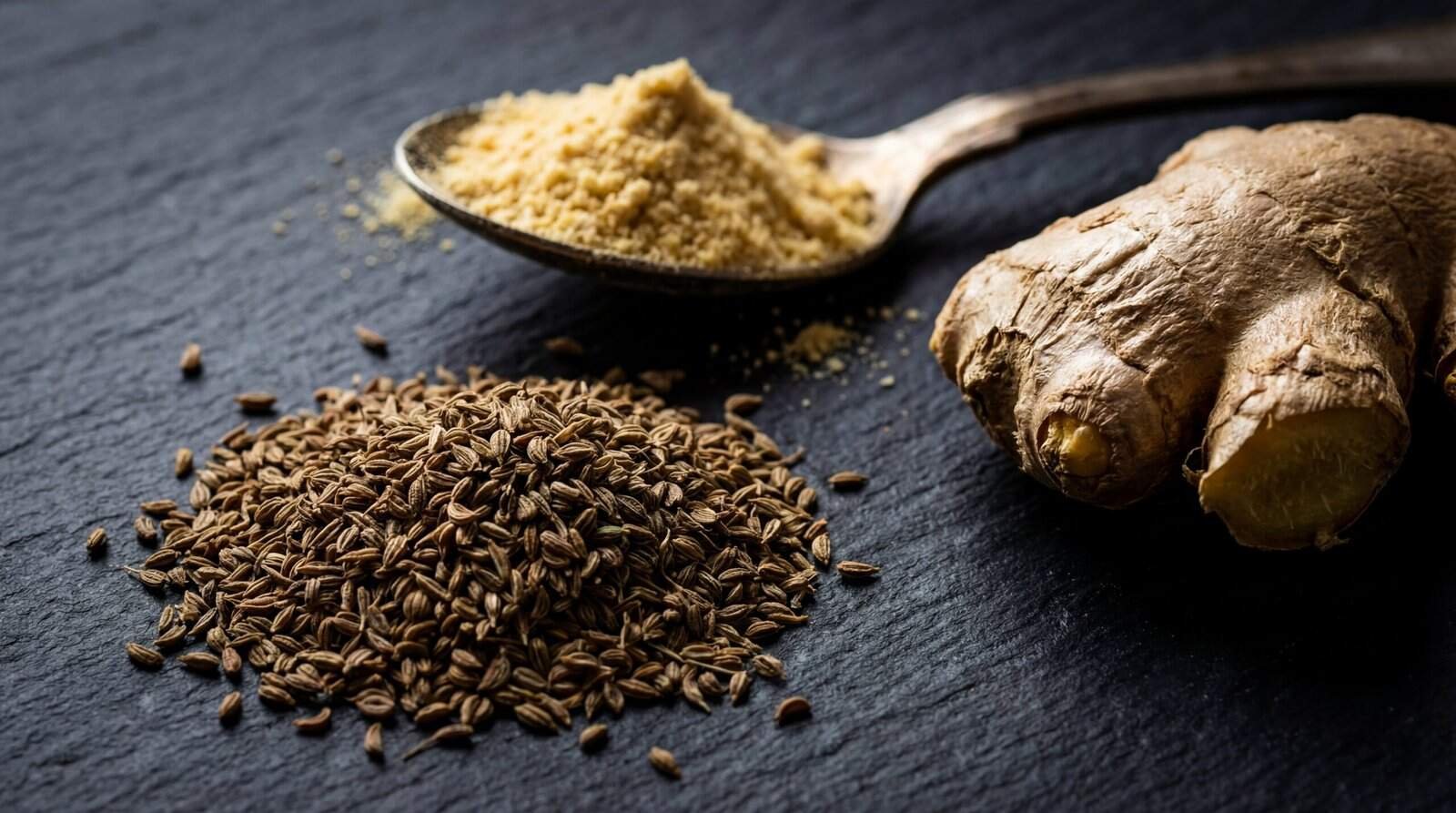
Ajwain (Carom Seeds)
If you grew up in an Indian household, you know the distinct, sharp smell of Ajwain. It is the MVP of digestive care.
How to take it: The simplest way is the “Phanki” method. Take half a teaspoon of Ajwain seeds and a pinch of black salt. Chew it up (yes, it’s spicy/bitter) and swallow it with warm water. You can also boil a teaspoon of seeds in a cup of water until it reduces a bit, strain, and drink.
Benefits: It provides almost instant relief from gas pains and bloating. It cuts through the heaviness. If you’ve eaten something too rich or fried, Ajwain is your best friend.
Hing (Asafoetida)
Hing smells strong—some people say it smells bad—but it is powerful stuff. It acts as an antiflatulent (stops gas) and an antispasmodic (stops cramps).
Method of use: Never eat raw Hing; it’s too strong. You have to cook it. Add a pinch to hot oil or ghee when you are starting to cook your lentils or vegetables. If you have a gas pain in your stomach right now, here’s a trick: Mix a pinch of Hing with a few drops of warm water to make a paste. Rub this paste around your belly button (navel). It sounds weird, but it works wonders for releasing trapped gas, especially in babies or kids.
Best for: Vata-related gas. The dry, distended, painful bloating.
Ginger (Adrak)
How to use it:
- To start the fire: Before a meal, grate a small piece of fresh ginger. Add a drop of lemon juice and a pinch of salt. Chew this. It wakes up the salivary glands and prepares the stomach for food.
- To clean up the mess: If you already have indigestion, drink ginger tea (dry ginger powder is actually hotter and better for deep digestive issues than fresh ginger) after the meal.
Role in strengthening Agni: It literally adds heat. It cuts through the heavy, sticky Kapha mucus and regulates the airy Vata movement.
Triphala
Triphala isn’t a laxative, though people use it as one. It’s a Rasayana—a rejuvenator for the gut. It’s a mix of three fruits: Amla, Haritaki, and Bibhitaki.
Night-time use: Take one teaspoon of Triphala powder with warm water right before bed.
Benefits: It doesn’t force you to go to the bathroom; it tones the colon muscles so they work better on their own. It gently scrapes Ama (toxins) off the intestinal walls. It’s safe to use for long periods, unlike harsh laxatives like Senna.
Jeera–Saunf–Dhaniya Water (CCF Tea)

This is the holy grail of gentle Ayurvedic detox. It stands for Cumin, Coriander, and Fennel.
Preparation method: Take 1 teaspoon of Cumin seeds (Jeera), 1 teaspoon of Coriander seeds (Dhaniya), and 1 teaspoon of Fennel seeds (Saunf). Boil them in 4–5 cups of water until the water reduces to about 3–4 cups. Strain it and put it in a thermos. Sip this warm water throughout the day.
Why it works: It hydrates you, but more importantly:
- Jeera burns Ama.
- Dhaniya cools heat and acidity.
- Saunf stops cramping and gas. It balances all three Doshas. You can drink this every single day.
Buttermilk (Takra)
Wait, isn’t dairy bad for digestion? Heavy milk is hard to digest. Yogurt (Curd) is heavy and heating. But Buttermilk is nectar. In Ayurveda, we say, “He who drinks Takra daily never suffers from disease.”
Correct way to consume: This isn’t the thick, creamy stuff you buy in a carton. Take 2 spoons of yogurt. Add 1 cup of water. Blend it until it’s frothy. Skim off the fat/butter that rises to the top. Add a pinch of roasted jeera powder, a pinch of black salt, and maybe some coriander leaves.
Benefits: It is full of lactobacillus (probiotics). It is light, easy to digest, and astringent, which helps bind loose stools while improving absorption. Drink this with lunch, never at night.
Ayurvedic Diet Tips to Improve Digestion
It’s not just what you eat, it’s how you eat. You can heal your gut just by changing your habits.
Eat warm, freshly cooked food Your stomach is a warm environment. Putting cold salad or a cold sandwich into it is a shock. Cooked food is “pre-digested” by the fire of the stove, making it easier for your internal fire to handle. A warm bowl of soup is infinitely better for weak digestion than a raw kale salad.
Avoid drinking cold water with meals Imagine you are cooking a soup on the stove, and every few minutes you pour a cup of ice water into the pot. The soup will never cook. That is what drinking with meals does. It dilutes your digestive enzymes (acid). Sip a little warm water if you need to, but don’t gulp down a huge glass.
Proper food combinations Keep it simple. Eat fruit alone. Don’t mix milk with meat or fish. Don’t mix cheese with beans. The simpler the meal, the easier the digestion.
Ideal meal timings
- Breakfast: Light and warm. Digestion is just waking up.
- Lunch: The biggest meal. The sun is high, your fire is high. Eat your grains, proteins, and heavier foods now.
- Dinner: Light and early. Finish by 7 PM if possible. Soups, lentils, cooked veggies. No heavy meats or yogurt.
Lifestyle & Daily Habits to Strengthen Digestion
You can’t supplement your way out of a bad lifestyle. Here are the non-negotiables.
Walking after meals (Shatapavali) The rule is “100 steps.” After you eat lunch or dinner, do not sit on the couch immediately. Do not sleep. Walk 100 steps. Just a gentle stroll. It mechanically helps the food settle and stimulates peristalsis (the movement of the gut).
Early dinner I mentioned this before, but it bears repeating. If you go to sleep with a full stomach, your body cannot enter “Deep Sleep” repair mode because it’s stuck in “Digestion” mode. You wake up groggy, with a weird taste in your mouth, and stiff joints. Leave a 3-hour gap between dinner and bed.
Stress management We glorify “the grind,” but the grind is destroying our guts. Before you eat, take three deep breaths. Just three. It shifts your nervous system from Sympathetic (Stress) to Parasympathetic (Rest and Digest). If you eat while arguing, watching the news, or driving, you aren’t digesting.
Proper sleep routine Your liver cleans your blood between 10 PM and 2 AM. If you are awake watching Netflix at midnight, the liver can’t do its job. The toxins circulate back into the blood. Go to bed by 10:30 PM.
Foods to Avoid if You Have Gas & Indigestion
If you are currently suffering, cut these out immediately. Think of this as an elimination diet to let your fire recover.
Cold drinks and ice-cold foods: Just stop. Room temperature water only.
Fried and junk food: This is obvious, but heavy oils clog the channels of the body.
Excess curd (Yogurt) at night: Yogurt is “Abhishyandi”—it blocks the channels. It causes mucus and congestion. Never eat it at night, and never eat it cold if you have congestion.
Refined flour (Maida) and sugar: Refined flour is like glue in your intestines. It sticks to the walls and ferments. Stick to whole grains.
Raw foods: If you have gas, raw vegetables are hard to break down. Steam them, sauté them, bake them. No raw salads until the gas is gone.
When Should You Consult an Ayurvedic Doctor?
While home remedies are fantastic for day-to-day maintenance, there are times when you need professional help. Don’t play hero if:
Chronic gas or bloating: If you look 6 months pregnant every single day, no matter what you eat. Frequent acidity or reflux: If you need antacids multiple times a week. Long-term constipation: If you are dependent on laxatives to go. Weight loss or fatigue: If digestive issues are making you lose weight unintentionally or you feel exhausted all the time.
These could be signs of deeper issues like IBS, chronic gastritis, or even more serious conditions. An Ayurvedic doctor (Vaidya) can check your pulse (Nadi Pariksha) and give you specific herbs tailored to your body type.
Conclusion
Here is the bottom line.
In modern medicine, we tend to treat the body like a machine with separate parts. If the head hurts, take a pill for the head. If the stomach hurts, take a pill for the stomach.
Ayurveda teaches us that it’s all connected, and the center of that connection is your belly. If you fix your digestion, you don’t just fix the gas. You clear your skin, you sharpen your mind, you improve your sleep, and you boost your energy.
It doesn’t happen overnight. You can’t drink one cup of ginger tea and expect a miracle. But if you start respecting your Agni—eating warm food, eating on time, and listening to your body signals—you will see a change.
The bloating will go down. The heaviness will lift. And that internal fire will start burning bright again.
Start with one small change today. Maybe it’s the warm water. Maybe it’s the early dinner. Just start.
FAQs
“Cured” is a tricky word because if you go back to bad habits, the gas will come back. But yes, Ayurveda can resolve the tendency for gas by fixing the root cause (weak Agni). Once your digestive fire is strong, you won’t get gas from every little thing you eat.
It depends on how long you’ve had the problem. For minor issues, you can feel better in 2–3 days of eating warm, light food (like Kitchari). For chronic issues that you’ve had for years, give it at least 4–6 weeks of consistent lifestyle changes to see a real shift.
Generally, yes. It is considered a food supplement rather than a medicine. However, it’s always good to take breaks. Maybe take it for 3 months, then take a 2-week break. And if you are pregnant, always consult a doctor first.
Think “mushy.” Khichri (rice and moong dal cooked together), vegetable soups, stewed apples, well-cooked oatmeal, and warm broths. Anything that requires very little chewing and is warm and moist is best.